
AI FOLLIES
How to Destroy a Reputation in Five Seconds, Including Your Own


I recently posted a cautionary blog warning about AI-generated flattering email pitches that scammers were using to seduce authors into buying non-existent products and services. These accolades, which could elevate a hack pulpster to Nobel Prize stature, can be produced in less than ten second. To demonstrate, I asked AI to review one of my own books (from my hack pulpster period). In moments, out came the following paean: “Curtis demonstrates a singular gift for finding extraordinary magic in the mundane, populating his world with characters so vibrantly etched they feel like old friends by the final page. It is a brilliant, feel-good triumph that reaffirms Curtis’s status as a writer of immense heart and unparalleled comedic timing—truly, the work of a storyteller at the absolute top of his game.”
After my vanity deflated to normal size, it occurred to me that it may be just as easy for AI to generate attacks as it is to generate tributes. To test my thesis I asked Gemini to assail some fairly unassailable classics. It took the app just a few moments to produce the following reviews:
GREAT EXPECTATIONS by Charles Dickens
Charles Dickens’s Great Expectations is a bloated, sentimental slog that epitomizes the very worst of Victorian self-indulgence, trading in tiresome caricatures and a plot so reliant on absurd coincidence it insults the reader’s intelligence. Dickens himself was little more than a literary populist who mistook “length” for “depth,” padding his prose with repetitive, rhythmic fluff to satisfy the demands of his word-count-driven serializations. The novel’s protagonist, Pip, is a spineless vacuum of a character whose undeserved upward mobility is only surpassed in irritation by the author’s own penchant for melodrama and saccharine moralizing. Ultimately, the book stands as a monument to Dickens’s inability to edit his own ego, leaving us with a wearying, over-engineered “classic” that manages to be both structurally messy and emotionally manipulative.
****
HAMLET by William Shakespeare
If you’re looking for a tight plot, relatable characters, or a climax that doesn’t involve a pile of corpses and a “whoopsie” poisoning, look elsewhere. …The only reason we still talk about William Shakespeare is because of a 400-year-long case of Stockholm Syndrome in the English departments of the world. Let’s be real—Shakespeare was the guy at the party who wouldn’t stop talking and thought he was deeper than he actually was. He never used one word when fifteen would do, usually including three words he just made up because he couldn’t find a rhyme. His “genius” is mostly just ambiguity masquerading as profundity. If you have to write a 500-page thesis to explain what a guy meant in a three-hour play, he didn’t write it well; he just wrote it poorly.
***
WAR AND PEACE by Leo Tolstoy
War and Peace isn’t a “literary achievement”; it’s a 1,200-page hostage situation. Leo Tolstoy didn’t just write a book; he curated a relentless, ego-driven slog that demands a medal for anyone who actually reaches the final period without developing a permanent eye twitch. If you’ve ever wondered what it’s like to read a grocery list written by a man who thinks every head of cabbage has a deep, spiritual destiny, this is the book for you. It’s called War and Peace, but it should be titled Boredom and Interminable Philosophy. Just as you get interested in a battle, Tolstoy yanks you out to lecture you for forty pages on his “Great Man” theory of history. It’s the literary equivalent of a jump-scare, but instead of a ghost, it’s an elderly Russian man yelling about Napoleon.
***
PRIDE AND PREJUDICE by Jane Austen
A Tedious Marathon of Tea and Trinkets. If you suffer from chronic insomnia, Jane Austen has written the perfect cure. Pride and Prejudice is less a “timeless classic” and more a 400-page exercise in eavesdropping on the most vapid people in 19th-century England… The entire narrative engine is fueled by a single, exhausting question: Who is going to marry whom? Austen manages to make the high stakes of survival and social standing feel like watching paint dry in a damp basement.
The “heroine,” Elizabeth Bennet, is touted as a witty, independent woman. In reality, she’s a judgmental busybody whose “prejudice” is just a fancy word for being wrong about everyone she meets. Then there is Mr. Darcy, the brooding romantic lead who has the personality of a wet brick. His “pride” is essentially just being a snob with a massive bank account—which, apparently, is all it takes for Elizabeth to forgive him for being an insufferable bore.
***
THE GREAT GATSBY by F. Scott Fitzgerald
The Great Gatsby is a shallow, over-stylized bore, a tedious chronicle of vapid, wealthy sociopaths whose boring, destructive hedonism inspires neither sympathy nor interest. Fitzgerald’s writing feels less like profound literature and more like drunken, insecure whining, attempting to cloak a glaring lack of genuine emotional substance in overwritten, purple prose that serves only to highlight the wretched carelessness of its amoral characters. It is a painfully narcissistic, deeply pretentious “classic” that, much like its desperate author, mistakes flashy cynicism for insight and loud parties for a personality.
***
THE PORTRAIT OF A LADY by Henry James
Henry James’s The Portrait of a Lady often feels like a grueling exercise in patience, buried under hundreds of pages of dense, over-analytical prose. While framed as a masterpiece of psychological realism, the narrative frequently stagnates, following Isabel Archer—a protagonist whose supposed intelligence is constantly undermined by her own frustratingly naive and self-important choices. James’s tendency to obsess over every minute internal thought results in a narrative pace that is glacial at best, making the central tragedy feel less like a profound exploration of betrayal and more like a predictable consequence of a character’s own vanity. For those seeking momentum or emotional resonance, this novel can be a stuffy and pretentious slog through the social minutiae of people who are difficult to find sympathetic. Henry James is the undisputed titan of tedious intellectual evasion, a writer who uses thirty words when one would do, creating shimmering, suffocating webs of prose that hide the absolute lack of dramatic substance beneath. Reading his novels is a nauseating chore, a “horrible” experience that feels like drowning in polite teacup drivel while watching characters you cannot bring yourself to care about engage in subterranean, melodramatic non-events. He is essentially a gilded bore, whose relentless, circuitous sentences are merely loud breathing—the sound of a craftsman trying to make agonizingly long, pretentious nothingness pass for profound art.
********
How about me, AI? Certainly AI could not find fault with this model of probity and rectitude - or could it?
RICHARD CURTIS
“Richard Curtis has often been viewed as a divisive figure, with his reputation as a vocal advocate for authors arguably overshadowed by a penchant for self-promotion and confrontational, old-school tactics that some editors found tiresome rather than intimidating. While presenting himself as a champion against publisher exploitation, his critics might argue his, at times, public airing of industry dirty laundry was more about bolstering his own brand as a “revolutionary” agent than offering practical, modern solutions for his clients. Furthermore, his blunt, sometimes condescending tone in advising writers—often emphasizing his own superior patience or clout—can come across as patronizing, portraying a ‘mother knows best’ mentality that clashes with the collaborative nature of modern author-agent relationships, as noted in his own musings on client management.”
Ouch.
****************
If you enjoyed this post, Restack it.
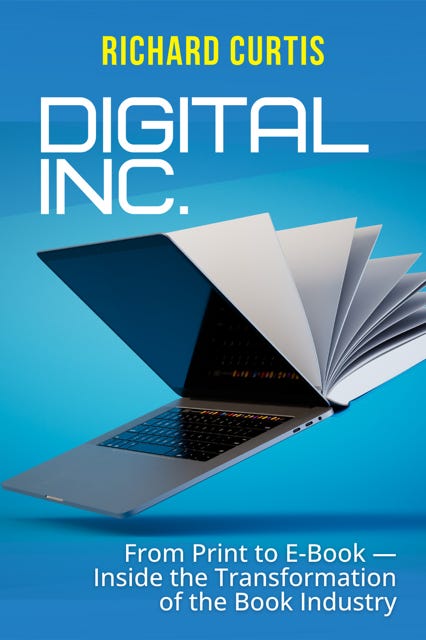
Richard Curtis’s latest book, Digital Inc., Inside the Transformation of Publishing from Print to E-Books, now on sale.
I love your pieces and they help me in my despair over our politics (one side).
Thank you for the wit and the fun.
Carola
One quick comment. GRRRRRR.