
LOOSE CANON
Should Your Agent Be Your Publisher Too?

The Association of American Literary Agents (AALA) is the principal organization of professional literary agents in the United States. Its mission statement, which all of its current roster of 765 members are pledged to uphold, is called the Canon of Ethics. It is a list of principles defining proper fiduciary and ethical conduct, which is summarized in the Canon’s preamble: “Full commitment to honorable and ethical business practices is crucial to our work.” For authors shopping for representation, an agent’s membership in AALA all but guarantees honesty and reputability.
You would think the precepts prescribed by the Canon are as immutable as the Ten Commandments. However, a revision of the code in 2022 and a “comprehensive reevaluation” announced this past week indicate that, from time to time, the organization adjusts its rules in response to changes in the publishing landscape since the Canon was devised by the organization’s founders. (The original organization, the Society of Authors’ Representatives, was founded in 1928, and the more recent one, the Independent Literary Agents Association (ILAA) created in 1977. The two groups merged in 1991 to form the Association of Authors’ Representatives (AAR), the precursor of the current organization.)
The 2022 revision was not radical; it opened up membership so that not just principal agents but their employees (such as foreign rights managers, social media specialists, and even assistants) could belong too. The latest upgrade, however, reflects significant departures from ironclad – or should I say hidebound - policies that have been in effect for decades.
Let’s drill into the changes and understand why they were instituted. I bring some special insights into the issues. I was the first president of ILAA and second president of AAR. I helped to formulate the Canon of Ethics. I also violated it, precipitating my resignation, as I will presently relate.
To help you understand the rationale for revising the Canon, AALA has furnished a helpful abstract. “The Canon,” it explains, “was originally created in the twentieth century,” Indeed, in 1991, when the AAR was founded and the “modern” Canon written, there was no Amazon, no Internet, no cell phones, no web sites, no e-books, no social media, no self-publication apps, no AI.
What has changed? How about everything? AALA’s abstract explains: “We have seen publisher consolidation, the advent of entirely new publishing models, the rise of digital media, social media, mobile technology, the challenges of AI, et. al, as well as the loss of physical retail space and traditional review media. Author/creators increasingly operate across a wide range of platforms, services, and competencies.”
Over the last half decade, the gradual relinquishment of publishers’ responsibilities has shifted numerous burdens - numerous uncompensated burdens - onto the shoulders of agents. It started with publishers shutting their slush piles (unsolicited manuscripts), necessitating agents to take over the job of reviewing and processing thousands of submissions that used to be handled by publishers. In time agents found themselves editing manuscripts, writing jacket copy, building websites and designing social media campaigns. On top of which, authors began pressuring their agents to do more for them or risk losing them to self-publishing.
This unprecedented flood of demands and new responsibilities motivated agents to seek relaxation of AALA rules, especially those concerning additional compensation beyond commissions. The revised Canon now states: “A member or member’s agency may employ staff or specialists to aid clients [and non-clients] in other areas such as marketing, promotion, web design, or other work, for a fee to be mutually agreed.” This right, however, is granted only on the condition that agent-members inform their clients of these additional fees and continue to observe specific legal, ethical and fiduciary protocols. In a conversation with Publishers Weekly, AALA president Regina Brooks said, “The authors have to do the lion’s share of the work, and a lot of clients were asking agents how to do it. We really needed to make sure that, if they were going to be offering up this information for authors, there was a way to charge for it.”
Perhaps the most notable innovation in AALA’s upgrade is the right of agents to also function as publishers: “While the AALA does not encourage its members to act as publishers of their clients’ work because of the inherent conflicts, doing so may be permissible if the member and client fully execute [a consent form prescribed by AALA] or a similar agreement containing all of its substantive provisions.”
My experience as agent/publisher can shed some light on the challenges of being both at the same time.
As some of you may know (the complete story is detailed in Digital Inc.), while still a literary agent I started an e-book publishing company in 1999. Throughout the nineties I had tracked advances in digital technology and, in anticipation, recovered the rights to hundreds of out-of-print books by our agency’s clients. With that trove I launched one of the first e-book publishers in the world. There was one little problem, however: a key provision of the AAR’s Canon of Ethics read: “Members shall not represent both buyer and seller in the same transaction.” Ostensibly, I was in violation of that provision.
However, by building a “Chinese wall” between my agency and my publishing company and keeping the two functions at arm’s length, I made sure our agency was in compliance with the Canon. Unfortunately, the AAR’s ethics committee was uneasy. They saw too many ways the wall could be breached or subverted. Though I was confident that that would not happen (and in the fifteen years of the company’s existence it never did) I did not want to start an embarrassing quarrel with the organization. I tendered my resignation.
For several years I remained the sole claimant of this hybrid business model. But in time I noted that some other agents had begun e-book publishing ventures too, and to my knowledge they had gone unchallenged by AAR. It was clear that the digital revolution had created opportunities that agents had never before enjoyed, such as the ability to publish books that trade publishers had turned down. It made less and less sense for the Association to rigidly prevent members from crossing the line. Last week they yielded to the new reality.
That said, it’s my turn to raise some troubling business and ethical concerns. Starting a publishing company these days is a piece of cake; commercial platforms for print and e-book production are a dime a dozen. But those are tasks that authors can do themselves. If an agent is going to publish their client’s work, they should be able to add value to off-the-shelf uploading of texts. They need to provide services comparable to those offered by legacy houses, such as distribution, marketing, customer service, credit card fulfillment, publicity, promotion and social media support. Is your agent-publisher set up to produce audiobooks? To license foreign, movie or television rights? To pay advances?
Business considerations aside, the very temptations that concerned the Ethics Committee when I created my publishing company are still of concern. One example: Suppose a foreign publisher wishes to license your book: does your agent handle the deal for 15% commission? Or does your agent/publisher handle it for 50% commission?
Though I am no longer a member of the Association, I continue to uphold the admirable tenets of its Canon of Ethics. I fervently hope that any agent venturing to become a publisher will do so too.
********************
If you enjoyed this post, Restack it.
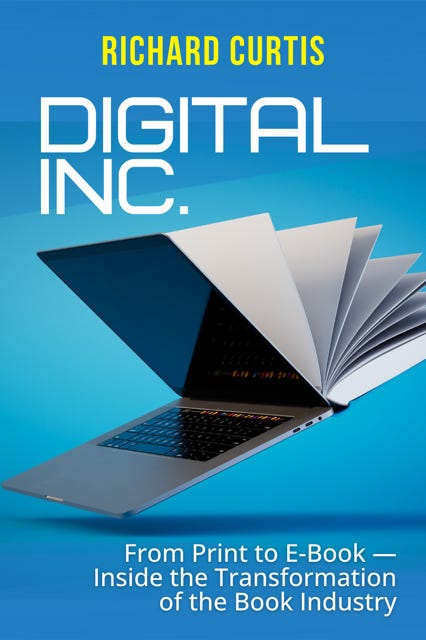
Richard Curtis’s latest book, Digital Inc., Inside the Transformation of Publishing from Print to E-Books, is now on sale.
“In Digital Inc., Richard Curtis has penned the Rosetta Stone for anyone interested in the tectonic shift in book publishing from print to digital. Curtis not only tells a fascinating and extraordinarily well written business story but also shows how the dramatic changes in publishing impact our daily digital lives. I learned more from Digital Inc. than from any other book about the digital revolution.”-Roger Cooper, former Senior VP and Publisher, the Berkley Publishing Group
Another wise and fascinating piece,
Thank you for your wit and wisdom!
Carola
From what I've seen over the years, you've always made waves. :)