
IT HAPPENS EVERY SPRING
Summer Internships in Publishing


Every year, starting around April, publishers and literary agencies are swamped with emails and phone calls from college grads and undergrads seeking summer jobs, internships or full-time employment.
Perhaps I’m sentimentalizing but it does feel more challenging for applicants today than in the past, and it turns out that statistics support this contention. The US Bureau of Labor Statistics reports that book publishing jobs declined from 91,100 in 1997 to 54,822 in 2023.
One reason is that over the last three decades, digital technology has streamlined many manual and mechanical processes. As I point out in my book Digital Inc., “Just about everyone in the book industry has upgraded to a higher technological mindset, from editors (using track-change software to edit scripts, for example) to contract managers (DocuSign) to bookkeepers (QuickBooks) to marketers, publicists, social media specialists all the way down to mail clerks.”
Another reason it’s harder to land a temp job or internship is the hardening of rules concerning unpaid and underpaid employment. In August 2024, New York State enacted the “Freelance Isn’t Free Act” making it harder for employers to use free or sub-minimum wage employees, and that includes publishers and agents. Cheap contract labor was not just exploitative but was also way for employers to avoid paying taxes, Social Security and other benefits for persons doing the work of full-time employees – generically described as The Gig Economy. Now that publishers can’t evade those obligations, their criteria for hiring – even summer interns – have become far more stringent than before.
Many big publishers advertise excellent summer internship programs. Typical is Simon & Schuster:
The Simon & Schuster Spring 2026 Publishing Internship Program offers students an immersive, behind-the-scenes introduction to the world of book publishing. Interns will be assigned to a specific department such as Editorial, Marketing, Publicity, Sales, or Production, where they’ll gain hands-on exposure to the full publishing process. Guided by a dedicated mentor, interns will experience the day-to-day responsibilities of an entry-level assistant, participate in departmental and company-wide meetings, and contribute meaningfully to ongoing projects.
No prior publishing experience is required; however, a genuine passion for books and storytelling is essential.
This is a paid, 8-week program, running full-time (40 hours/week) beginning in June 2026.
Eligibility Requirements:
· Must be able to commit to working 40 hours each week
· Must be a full-time undergraduate or graduate student
· Must submit a resume and cover letter; please indicate your department(s) of interest in your cover letter
Compensation is usually hourly and varies from publisher to publisher but is competitive with many other industries. Macmillan for instance offers $17 per hour (I was tempted to apply).
Despite hostility in certain governmental quarters to Diversity, Equity and Inclusion, the summer offerings promoted by publishers proudly stress DEI and similar programs like We Need Diverse Books. A very attractive feature of WNDB is that it offers supplemental $3,000 grants to eligible interns (at least as of this writing) Another is that WNDB accepts remote internships. Macmillan posts: “We particularly encourage applications from groups traditionally underrepresented in publishing, including but not limited to BIPOC, LGBTQIA+, veterans, and people with disabilities.”
Because jobs with Big Five publishers (Simon & Schuster, Penguin Random House, HarperCollins, Macmillan and Hachette) are highly desirable, the odds of landing one can be discouraging. The obvious strategy for job-seekers, then, is to cast their net wide, applying to small presses and literary agencies and even non-trade book publishers, almost all of which are listed online or in numerous directories.
A less obvious, but in my opinion far more successful, strategy is to seek and accept any job, however distant from your dream position it may be. The majority of trade book applications are for glam editorial jobs, but those are obviously the most competitive and hardest to land. However, there are two important things you need to know about trade publishing. First is that it is an extremely fluid and upwardly mobile industry. Whatever position you start out in, in time you will learn of openings in departments closer to your heart’s desire. The second is that if you want to be an editor you will have to gain experience in such far-flung disciplines as finance, marketing, sales and publicity. Penguin Random House’s offerings cover the spectrum of positions:
· Editorial
· Managing Editorial
· Sales
· Finance
· Production Editorial
· Marketing
· Subsidiary Rights
· Graphic Design
· Production
· Legal
· Information Technology
· Publicity
· Operations
Wishing you good luck. When your boss tells you to take some agents to lunch, you’ll know where to find me.
*****************
If you enjoyed this post, Restack it.
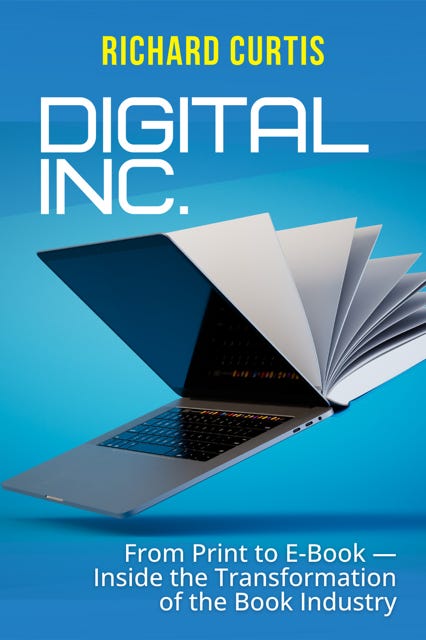
Richard Curtis’s latest book, Digital Inc., Inside the Transformation of Publishing from Print to E-Books, now on sale.
This brings back great memories of my summer internship. How lucky I felt!
If you want to publish books there's nothing like an internship or job in publishing. But any job in the entertainment industry is almost as good. TV, theater, music, all have the agents, producers, content editors, and execs you want to stay in touch with.