
CONTEXT
Include History in Your Cast of Characters

I am going to tell you two love stories.
In the first, John and meet cute (they are trapped together in an elevator during a blackout). They date, fall in love, and he proposes to her (also cute: when he kneels to ask her hand in marriage, his knee sinks into a pile of dog poop). But just before their wedding they quarrel (over his embarrassing habit of scratching his behind in public and her equally embarrassing habit of wiping her nose on her sleeve). They break up, but make up in time to recite their wedding vows, and they live Happily Ever After.
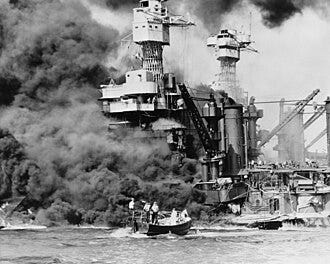
In the second story, John and Mary meet the same, date the same, and become engaged the same cute way. They set a wedding date, but it happens to be December 7, 1941. And on that infamous day, Pearl Harbor is attacked and the nation goes to war. Impulsively, John enlists in the US Army and departs for basic training before their wedding can take place. In time he is shipped overseas. Jane goes to work in an aircraft factory. John is wounded in the Battle of the Bulge and falls in love with a French nurse. Jane falls in love with the factory manager. They write each other Dear John/Dear Jane letters and marry their new loves. In time John’s wife and Jane’s husband pass away, and John and Jane reach out to each other, reconnect, marry, and live Happily Ever After.
I don’t have to tell you which is the more important or interesting story. When you compare them you realize that, except for one element, the formulas are identical – boy meets girl, they fall in love, something comes between them, they are ultimately reconciled. But the historical context of the second story provides far greater – infinite! - options for plotting complications. Unfortunately, many novelists don’t pay sufficient attention to time and place when setting their story. Their tales seem to be set in a vacuum
Think of history not as an inert thing but as a living character, sometimes benevolent, sometimes malevolent, but always affecting the thinking and decisions of your Johns and Marys. Love and loss, triumph and hardship, shattering despair and soaring joy, all these elements are made possible by events in the outside world impacting their behavior and freedom of will.
That range of emotions is almost impossible to duplicate in a novel whose superficial characters live in a formulaic fishbowl. Many circumstances that seem forced and incredible become completely believable when caused by the so-called Fickle Finger of Fate. Your readers are more inclined to credit a chance encounter, a stroke of luck, a coincidence, as totally natural, whereas if you tried it in first example, it would play as unbelievable, some deus ex machina you contrived to make the plot conveniently work.
History – and that includes recent or current events - provides opportunities for all sorts of colorful description. In our war story, the clothes and hair styles and food and vehicles color the culture and life style of the 1940s. Trivial objects - a locket, a coin, a hat, a photo, a button - can take on symbolic and even cosmic significance when the stakes are higher than a prom dance or a date at the soda fountain. You can employ 9/11 or the Recession of 2008 or the Covid Pandemic of 2020 to the same effect.
Yes, these suggestions require some research, but it is very much worth your investment of time to immerse yourself in nonfiction. Whether it be Edwardian clothing, Medieval weaponry, Celtic jewelry, or Roman aqueducts, the details will enhance your story and lend authenticity to your fiction.
****************
If you enjoyed this post, Restack it.

Richard Curtis’s latest book, Digital Inc., Inside The Transformation of Publishing from Print to E-Books, now on sale.
Great advice. So many books today exist in no history at all and thus no real world, that I find them flat and lifeless. You might call their period the Eternal Suburban Now.
That said, the same could be said of Agatha Christie mysteries, a quality that makes them timeless, but their attitudes are so of the times that the times are given away.
I love this post, especially since I'm writing historical fiction! It's important to do the research, but once done, it serves as a rich and evocative framework for plot and character. Just remember not to make the mistake one of my beta readers caught this all-American author making, and don't have French school children in the 1940's snacking on milk and cookies;)