
BELLY UP
The bankruptcy clause of publishing contracts is a myth.

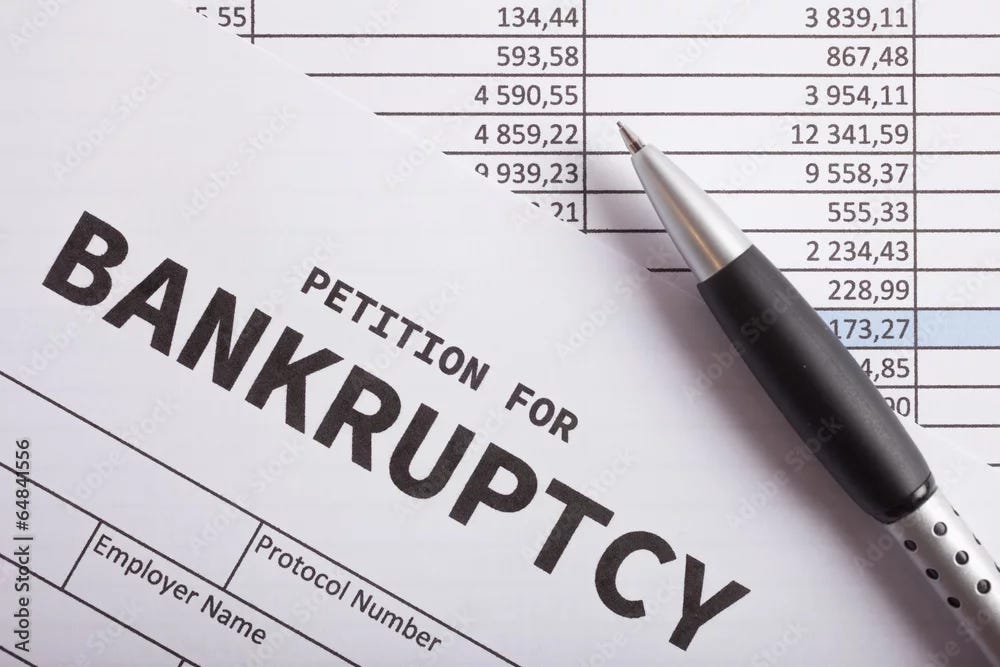
Not a good beach read
If you’re looking for a great work of fiction, you only have to look at the bankruptcy provision of your book contract. In essence it states that if your publisher files for bankruptcy you can get back the rights to your book. Unfortunately, that is completely untrue. As soon as a publisher seeks protection under bankruptcy laws, author contracts are frozen and unrecoverable for the duration of the proceedings and possibly beyond.
A typical book contract bankruptcy provision looks something like this:
If (i) a petition in bankruptcy is filed by Publisher or (ii) a petition is filed against Publisher and is finally sustained or (iii) a petition for Arrangement or Reorganization is filed by or against Publisher and an order is entered directing the liquidation of Publisher in bankruptcy, or (iv) if Publisher shall make an assignment for the benefit of creditors, then Author may, at Author's option, terminate this Agreement by written notice and, thereupon, all rights granted herein shall revert to Author.
Ostensibly there is no question about the procedure for getting your rights back. All you have to do is send your publisher notice terminating your contract. Right?
I have bad news for you.
The Law
According to bankruptcy attorneys, the provision is unenforceable. When a company files for bankruptcy, all of its assets are subject to seizure by its creditors. Among those assets, and perhaps the most valuable, are contracts with authors. Whoever eventually acquires those contracts takes possession of them, and there’s almost nothing you can do about it. That company might be a bank, an investment company, a carpet-cleaning firm or whoever the bankruptcy referees deem a legitimate buyer. Hopefully it will be a viable publishing company.
We also learned that authors are not “secured creditors.” A secured creditor is an entity whose credit is secured by collateral such as a bank. The claims of secured creditors take precedence over those of mere authors.
To make sure about these facts, I consulted with a lawyer friend of mine, Michael A. Gerber, a dean of Brooklyn Law School, who had published a book about bankruptcy. He cited provisions in the federal Bankruptcy Code that invalidate the bankruptcy termination clauses of contracts. It turns out that book contracts are regarded by Congress as assets comparable to the furniture, computers and light fixtures of a publisher. Section 365(e) (1) of the Code stipulates that an executory contract (that's what you have) may not be terminated when your publisher goes into bankruptcy. Gerber’s opinion was reinforced just recently (May 2025) when bankruptcy attorney Marc Hirschfield, on an Authors Guild webinar, confirmed that “the bankruptcy code overrides” the clause in book contracts entitling authors to recover their rights when a publisher files for bankruptcy.
The reason is that if a company is trying to reorganize or find a rescuer in order to work things out with its creditors, as it may do in a so-called Chapter 11 case (the bankruptcy code is divided into chapters), those contracts are a key source of potential revenue. Even if a company is completely liquidating (under Chapter 7), the law still regards the earning potential of your contracts as an asset to which creditors have some claim. Thus, you may not get your rights back if your publisher elects to assume the benefits and obligations called for in your contract. There is some saving grace in all this in that the company cannot keep you dangling interminably. In a Chapter 7 liquidation case, the company must decide whether to assume or abandon the contract within sixty days of filing. In a Chapter 11 (reorganization) case, there is no hard-and-fast deadline, but the bankruptcy court may impose one in response to the pleadings of authors.
So, contrary to the black-and-white language of your publishing contract, you're up the creek, at least for an extremely uncomfortable while. Fortunately, when a publisher gets into financial trouble there is usually another publisher waiting in the wings. An ailing publisher's backlist may continue generating income for anybody who takes it over, and because most secured creditors of a publishing company (such as banks, printers, distributors, and the landlord) are incapable of generating income from the publication of books, sooner or later they will conclude that it makes good financial sense to turn author contracts over to a legitimate publisher.
The right to assign your contract
Most publishers have provisions in their book contracts permitting them to assign those contracts to any entity without the author's approval. Some agents and authors are able to modify that clause in negotiations so that a publisher cannot assign the rights without the author's express permission, but most publishers resist that modification as it ties their hands if they should want to sell their company. However, even if your contract prohibits your publisher from assigning your rights without your permission, that prohibition would be invalid, according to Professor Gerber.
Actually, the assignment of your contract to another publisher might be the best thing that can happen to you if you are worried that your books may be tied up for years in bankruptcy litigation or seized by some creditor who doesn't know a copyright from a coffin nail. For one thing, before a publisher can assume or assign a contract, it must pay you any royalties it owes you or at least provide you with a schedule of payment. Moreover, if your contract is assigned to another publisher, at least there is someone you can talk to, someone who will keep your book in print and generate some income for you.
Agents don't like to admit that there are things they are powerless to control, but bankruptcy appears to be one area where little an agent does by way of negotiating contractual language is going to help if your publisher goes belly-up; and once it does, little that an author, agent, or lawyer does will help if the bankrupt firm and its creditors don't want to cooperate with you. My best advice is to move like lightning once you or your agent sense that your publisher is in serious trouble, demanding immediate reversion of your rights and settlement of outstanding financial obligations. Make a horrid pest of yourself or hire an attorney (they are excellent pests) in the hope that your publisher will decide life is too short.
Although the Big Five publishers and the host of smaller companies seem financially stable at this writing, anybody who works in this business long enough knows that sooner or later Murphy's Law will clutch us by the ankle, and whatever terrible thing can happen will perforce happen. I have seen booming markets dry up overnight, omnipotent CEOs ignominiously ousted, and corporate mergers, acquisitions and divestitures wipe out publishers as casually as cards tossed in a low-stakes poker game.
It is mystifying to me why publishers promote the myth that you will get your rights back if they should file for bankruptcy. Yet the clause remains obdurately fixed in every book contract. Isn’t it time to get it out of there?
******************
A version of this article was originally published in Locus Magazine and reprinted in This Business of Publishing.
Richard Curtis’s books on publishing are available at Open Road https://openroadmedia.com/search-results/books/Richard%20Curtis
This is kind of hilarious, because CR law is basically imaginary. All an author would have to do in this situation is to self publish their book. Pursuing CR infringement in the courts, costs boatloads of money and even more effort.