
A Ghost Story
I Broke Curtis's First Law and Paid the Price

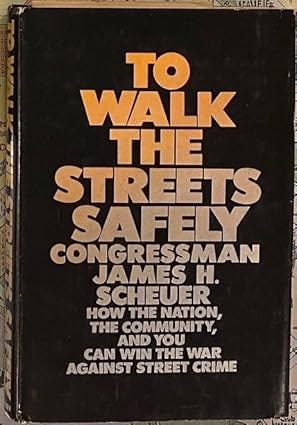
One day, when I was a freelance writer, Doubleday contacted me to ask if I would be interested in collaborating with New York Congressman James H. Scheuer on a book he wanted to write called To Walk the Streets Safely. New York City streets were definitely not as safe to walk on as they are now. They were even more hazardous to park your car on, as I soon discovered. But Scheuer had a special prescription for reducing crime: the role of science and technology in reinforcing the city’s policing and criminal justice system. I accepted the ghost job but soon learned that Scheuer had another motive besides civic duty for publishing a book. He was planning to run for mayor and believed that a book would give him a special advantage over his opponents.
I researched anti-crime technology and interviewed Scheuer to get his views. Most of the interviews were conducted in my apartment, where he had a maddening habit of perching a mug of coffee on the couch cushion on which he sat, so that every time he shifted his body or crossed his legs the mug would begin to capsize, and I spent many an anxious hour darting a hand out to steady the wavering vessel.
At that moment in the 20th century, word processing had finally eschewed carbon copies (although “cc” was rescued by the creators of email jargon). Thanks to the Xerox Corporation, a primitive form of home photocopy machine had been developed, and my technique was to write a chapter and feed the pages into the copier drum. The copies thus made were scarcely legible and eventually completely faded into invisibility. But at least I had something by way of backup then.
One winter night as I was close to completing the book, Scheuer called me. He was anxious to read my latest chapter. I explained that I had not yet made a copy. But he insisted on picking it up in the next few minutes. He was driving up to his home and had to show it to someone that very night. I protested, reciting Curtis’s First Law: If you let your only copy of a manuscript out of your hands it will be lost. “Impossible,” he scoffed as he took possession of the manila envelope with the chapter in it and drove off. The following Monday I phoned him to get the manuscript back. He did not return my call, nor did he return it for three days until I left a desperate message. At last he phoned. The reason for his delay in getting back to me was that his car had been stolen. I sympathized, but where was my manuscript? “Um, it was in the trunk.”
“What happened to those technological safeguards against car theft you told me about?” I inquired.
“Our book is about walking the streets safely. I didn’t say anything about parking the streets safely,” he joked. I didn’t laugh.
“You can just rewrite the chapter, right?” he suggested
Any writer who has had to reconstruct a lost text will tell you that it is ten times harder than composing the original. I wondered if the crime-fighting congressman had any technological safeguards against being punched in the mouth by his collaborator.
The book was presently published and Scheuer entered the Democratic mayoral primary proudly flogging our book as an essential credential for conquering crime in New York City.
He finished dead last behind Norman Mailer, who ran on a platform of New York City seceding. Mailer’s partner was the iconoclastic journalist Jimmy Breslin running for presidency of the New York City Council. In defeat Breslin lamented, “I am mortified to have taken part in a process that required bars to be closed.”
One good thing - at least it seemed good at that time - that came out of the book was an invitation to Washington by the staff of Rhode Island’s Senator Claiborne Pell. They had read the Scheuer book and were interested in hiring me to help write policy positions for the legislator. Two aides took me to lunch in an oaky DC watering hole and asked me if I had any ideas that might make a good platform for the Senator. I said yes, how about Urban Blight (a term then currently all the rage)? They said that sounded great, how about writing up a position paper? I said fine, but what was Senator Pell’s position? They said “He doesn’t have one, so why don’t you just write what you told us?”
“You want me, a freelance writer, to invent a position that Senator Pell doesn’t know he has, is that it?”
“Yes, exactly.”
I got on the next train to New York City, ending my illustrious career in national politics.
************
If you enjoyed this post, Restack it.

Richard Curtis’s latest book, Digital Inc., Inside The Transformation of Publishing from Print to E-Books, now on sale.
“You want me, a freelance writer, to invent a position that Senator Pell doesn’t know he has, is that it?”
“Yes, exactly.”
Ha! More than "inside agenting"... Inside politics! Good one, Richard. Thanks!
Dear Richard , you make my day and put me in a good mood with your wonderful , hilarious writings.
Warmly, Carola